Showing posts with label tcm. Show all posts
Thursday, January 10, 2013
Last Night on TCM...: Loretta Young Before the Code
Making her film debut as a child actress in the early teens before graduating to more adult fare at the ripe age of 15 in Lon Chaney's Laugh, Clown, Laugh (1928), Loretta Young is best remembered today for her Emmy-winning 1950s TV show "The Loretta Young Show", a classy drama anthology series featuring her in lavish gowns and family friendly fare, and winning the Best Actress Oscar in 1947 for The Farmer's Daughter. Young was a lifelong Catholic, her religion informing most of her career decisions, resulting in a beautiful squeaky clean image throughout most of her years in front of the camera. Of course years later, taking into consideration her divorces and her illegitimate daughter with Clark Gable, we know about Loretta's wild side, one she worked hard to keep from the public eye. Adding to the delicious tarnishing of an impossibly flawless image are her works in pre-Code films, putting her in, as Robert Osborne puts it, "salacious situations", ones that years later, after paying her dues and becoming a bigger star, she would never deign to appear in. As TCM's Star of the Month, every Wednesday packs the schedule with some of Young's most interesting and noteworthy films, and tonight is all about the pre-Code naughtiness that I find so irresistible. Almost all are from her first contract studio, First-National, the little company absorbed by Warner Brothers, and one of the best producers of lurid melodramas in the early 1930s.
Roy del Ruth's Employees' Entrance (1933) has developed a cult following over the years, especially after it appeared as part of MGM/UA's Forbidden Hollywood VHS series, and for good reason. Warren William, a favorite smarmy mustachioed heel in pre-Code films whose career floundered after Hollywood started cleaning up its act, stars as Kurt Anderson, a tyrannical employee at Franklin Monroe & Co., a giant department store he helps profit in the millions. Almost immediately after he threatens his way into a higher executive position, the store begins feeling the effects of the Depression and Anderson begins feeling the fire under his tush as he must continue proving his worth. He fires an elderly employee, and when he jumps out a window summarizes, "When a man outlives his usefulness, he should jump out a window." Young co-stars as Madeline Walters, a beautiful model who Anderson hires for the ladies' department and sleeps with as a reward, an action that comes back to haunt her when she secretly marries Anderson's new assistant (Wallace Ford), giving the vicious bastard ammunition to ruin their lives. Vibrant bleached blonde Alice White, the same year as her two-timing sex scandal virtually destroyed her career, is Polly, a flirtatious employee Anderson uses to seduce an executive to keep him distracted from the hostile takeover of the store.
Where other studios and films tried to avoid even using the word "Depression", First-National and Warner Brothers' socially-conscious films had no qualms working the poverty and fear of the era into their story lines. A Franklin Monroe board meeting desperate for ideas to save the store is reflective of many real-life meetings that must have taken place in large businesses nationwide. Kurt Anderson is one of the most evil "heroes" the silver screen has ever seen, an early example of an anti-hero that the audience could never root for. Scholars like Thomas Doherty have argued that Anderson is an unusual kind of sympathetic, a man without love in his life and licked by the Depression, which is a rather bold analysis of such a hateful and venomous protagonist. But he might have a point. Del Ruth doesn't punish Anderson by the end of the film, letting the humorless blackmailer off the hook, and reunites the young lovers, infidelity and all, after a suicide attempt. For some reason, this has remained MIA as part of the Warner Archives Collection, but it's one to look out for when it airs on TCM again. Further proof that First-National/WB made the best pre-Code films, Employees' Entrance is one of the most obscure and rewarding gems of the era.
Original theatrical trailer for Employees' Entrance (1933)
William Wellman's Heroes for Sale (1933) is a film I saw at Film Forum early last year, double featured with his equally potent drama Wild Boys on the Road (1933), and both are in the top tier of pre-Code films. Revisiting it on TCM, I still maintain that it's one of the best films of the 1930s, politically explosive and socially relevant, even today. Fading silent star Richard Barthelmess, before he left the screen for good, stars as Tom Holmes, a WWI vet who performs a heroic act, is left for dead on the battlefield, and is nursed back to health to return to the US, only to discover that an old friend has taken credit for his heroism. To make matters worse, his medical treatment has resulted in a morphine addiction, which leads to him losing his job and struggling to make a living. The film follows the ups and downs of Tom's life, as he marries beautiful Ruth (our Miss Young), only to lose her in a senseless labor riot tragedy, which also lands him in jail and on the FBI's watch list as he gets out and walks the roads of America with his fellow vets searching for work.
If someone asked me to name a handful of films to introduce newcomers to the wonders of pre-Code films, Heroes for Sale would be on that short list. Not only does the film feature controversial subjects forbidden in films post-1934 (drug addiction, violence, questioning authority), it contains some of the most poignant scenes capturing life in the Depression that any film, before or since, has ever shown. To say anymore would sound like mere rambling hyperbole, so just take it from me: see this film. It's available on DVD with several other marvelous Wellman pre-Code features, including Wild Boys, and is an essential addition to any classic film fan's library.
Original theatrical trailer for Heroes for Sale (1933)
Young was loaned out to Darryl Zanuck and 20th Century-Fox for one of her last pre-Code wonders, Born to Be Bad (1934). With a title like that, it has to deliver the tantalizing goods, right before the Production Code cracked down on films like this, featuring unwed mothers, immoral behavior, and rebellious attitudes. We first see our heroine, Letty Strong, in a stunning gown, drinking champagne and surrounded by male admirers at a swanky club in the opening sequence. The next shot: Letty in revealing lingerie in her bedroom. Yep, this is pre-Code all right. And just look at that poster above! When she isn't living the high life of a party girl, Letty is a single mother dealing with an unruly young son named Mickey (Jackie Kelk) who is constantly skipping school and causing trouble. She has a confidante named Fuzzy (Henry Travers), who helped the poor unwed mother when she was down on her luck (Mickey was born in the backroom of his bookstore), and a procurer named Steve who books her "appointments". Wild boy Mickey is run over by a milk truck driven by president of the dairy company, Malcolm Trevor (pre-stardom Cary Grant), giving Letty the wise idea to get Mickey to lie about his injuries to fleece Trevor of more money. The plan backfires, resulting in Mickey being taken from Letty and placed in a boys' home. Re-enter Malcolm, who adopts Mickey in order for Letty to be able to see her son on a regular basis. But this girl still has some bad left in her, as she tries to use her body and blackmail to get Mickey back on a permanent basis. As Malcolm says, "You're bad, bad all the way through. You're just a beautiful bad girl." Indeed!
Born to Be Bad is especially surprising considering it doesn't seem to even try hiding the fact that Letty is a prostitute. She refers to her clients by their hometowns (Detroit, St. Louis) and has phone conversations with Steve setting up her next tricks. But apparently, even with such controversial and obvious scenes, the film was plagued with censorship problems from the get-go, reportedly re-written and re-shot to please the Hays Office. All said and done, it doesn't seem to have made much difference; the film is still full of alarming sexiness and innuendo, as well as a cliched Jewish lawyer sure to raise eyebrows. Young is quite amazing in a role that must have been a challenge to her delicate sensibilities, speechifying about her rough past and her right to raise a child to face the world with strength and decency, and it's interesting to see her work with Cary Grant a full decade before they re-teamed for their enduring classic The Bishop's Wife (1947). Running a brief 62 minutes, the film just flies by and is a pleasant last gap of pre-Code badness.
Young worked again with director Wellman in Midnight Mary (1933), another film included in the pre-Code set with Heroes for Sale. While Wellman is remembered today mostly for his work on testosterone-driven films like Wings (1927), Blood Alley (1955), and The Story of G.I. Joe (1945), his films with women in the 1930s are exceptional and, for my money, the best of his career. Wellman's women are tough, no-nonsense, and frequently atypical of their contemporaries. Both Wellman and Young were borrowed from First-National/WB by MGM to make this one, and it pales in comparison to their work at their home studio, but it's still a good time to be had by those seeking Depression-era melodrama.
Introduced reading Cosmo while waiting for a jury to decide whether she's guilty of murder, Mary Martin (Young) sits with the court clerk (Charley Grapewin), remembering her past as it plays out before our eyes. Her mother dies when she is 9, she is caught for stealing and thrown into reform school, and gets out only to become a teenage prostitute walking the streets. But deep down, Mary is a good girl. She accidentally plays lookout for a hoodlum boyfriend of hers and guiltily donates her $50 pay-off to the Salvation Army. Anxious to get a decent job and pull herself out of poverty, she finds herself drawn back into the world of gangsters and crime by her girlfriend Bunny (Una Merkel), becoming the bitter kept moll of Leo Darcy (Ricardo Cortez). Seductive lawyer Tom Mannering (Franchot Tone, around the time he started dating Joan Crawford) offers her a way out, paying for secretarial school and helping her move towards her dream of becoming a businesswoman, and of course the pair fall in love. But there's no escaping your past, as Mary is tossed in jail for not squealing on the whereabouts of wanted man Leo and hooks back up with the louse upon her release.
In a role written by Anita Loos for MGM contract player Jean Harlow (who passed on it), Young does well with a multi-layered character, but at times self-consciously acts as if she knows she's replacing someone with more star power. Wellman, used to flying by the seat of his pants with quick shooting schedules and B-movie budgets, doesn't seem to be having much of a good time, either. Because this is MGM, the Depression presented here has a glossy look to it, robbing it of the sense of realism that First-National/WB brought to similar stories of girls gone bad around the same time. Amusing character actor Warren Hymer is fun as a comic relief hood, Andy Devine gives his trademark whine as Tom's buddy Sammy, and the marvelous Louise Beavers is (of course) wasted as Anna, Mary's maid. With plentiful innuendo and some fine characterizations, Midnight Mary isn't a complete waste, but it's not indicative of the kind of fun to be had with films of its type.
And we're back where pre-Code belongs, First National/WB, with They Call It Sin (1932). What a title, and what a delicious little morsel! Stranded in Merton, Kansas on a stopover during a business trip, Jimmy Decker (David Manners, the year after Dracula) becomes taken with lovely church organist and aspiring songwriter Marion Cullen (Young), a vibrant young girl whose parents feel that her spirited ways are downright sinful. Yeah, smiling a lot and walking down the street with a boy would really piss God off. Upon learning that the Cullens aren't really her parents, and her true mother was a trashy singer who made a pit stop in town while touring with her band, Marion decides to go for it and escape to New York City, where Jimmy will surely be happy to see her. She arrives to find Jimmy engaged to perky Enid Hollister (Helen Vinson), despite his continued feelings for her, and hits the pavement looking for work in the music business, pursued by Jimmy's best friend, Dr. Tony Travers (romantic lead favorite George Brent). A third man enters her life in the form of sleazy theatrical producer Ford Humphries (go-to villain Louis Calhern), providing Marion with a multitude of choices in her search for happiness and success.
Women in the Depression would kill for the opportunities given Marion in this film! At every turn, she finds herself presented with some new exciting possibility in work or romance, and this is what makes pre-Code films such interesting vehicles for their female protagonists. Even when they succumb to sinful temptation, it is often for good reason: the American dream. Young feels right at home as small-town goodie two-shoes Marion, and she is surrounded by great company. The male cast is like a Mt. Rushmore of handsome in the 1930s: George Brent, David Manners, and Louis Calhern. Triple swoon! Una Merkel, misused in Midnight Mary, is simply marvelous as Dixie Dare, the Southern belle dancer who adopts Marion in their mutual search for work in Manhattan. Hollywood never gave her the leading roles she deserved, but as a comic character actress, she proved memorable in almost everything. She appears here in a sultry scene prancing around in her underwear. Add always-great character actor Roscoe Karns (Shapely in It Happened One Night) to the mix and you've got a doozy of a cast in a delightfully compact little winner!
Three-minute preview clip of They Call It Sin (1932)
You'll need to prepare yourself for The Hatchet Man (1932). A film focused on Tong wars among Chinese immigrants in 1930s San Francisco, every key role is played by a white actor. Warner Brothers apparently could not (or would not) enlist the talents of Anna May Wong or anyone else of legitimate Chinese descent for a film without white characters. An opening credits crawl gives historical background to the Tong wars in San Francisco, described as having the largest Chinese population outside of the homeland. The "hatchet man" is defined as being the dispenser of justice, essentially a hired killer assigned targets by the leaders of a Tong. As hatchet man Wong Low Get, Edward G. Robinson is ordered to kill his childhood friend Sun Yat Ming (J. Carroll Naish), who forgives him before the deed but asks that Wong raise his daughter Toya (Young). Things get complicated and weird when Toya comes of age and Wong proposes to her...er, okay...but when he becomes distracted by a new Tong war, she begins a relationship with younger Tong gangster Harry (Leslie Fenton). Wong is expelled from the Tong for allowing the pair to elope and to regain his honor, he treks to China to right the wrong done to him.
Wellman, who had previously tackled Tong wars in the unusual silent-talkie hybrid Chinatown Nights (1929), develops beautiful atmosphere in the San Francisco streets and slums, as he did in that earlier film. The beheading execution scene of Yat Ming is nicely cross-cut with infant Toya's doll's head falling off, and there are some grotesque moments of uneasy violence throughout the film (including perhaps the best pre-Code ending of all). The political incorrectness of Hatchet Man makes it relatively difficult to watch in many scenes, especially with the ludicrous makeup used on Robinson, Young, and Fenton. One wonders why, if the unproduced play it was based on was purchased by WB, they didn't just translate the general storyline into an American gangster story, where it would have worked just as well. No one involved with this one looks back on it without embarrassment, and while it's not that much of a mess, it's pretty compellingly bad.
Watch the whole movie The Hatchet Man (1932), if you dare...
Young is back in the department store in Play-Girl (1932), a lovely salesgirl working with her best friend, wisecracking blonde Georgine (top-billed songstress Winnie Lightner, in one of only a handful of films before marrying director Roy del Ruth). Georgine and Buster are two young women eking out a living working behind the store counter, Buster in infant wear and Georgine in (gulp) plumbing supplies. They live in a tiny apartment in New York City while trying to land the perfect man. While Georgine sidles up to fellow employee Finky (brilliant character actor Guy Kibbee) in an effort to get out of plumbing, Buster is wooed by humorous charmer Wally (Norman Foster), and the quartet goes on a camping vacation together. Buster and Wally marry, but she discovers on their honeymoon that he's a career gambler, causing her to cast him out when she becomes pregnant and she doesn't trust him to support her and the baby. Of course this being the Depression, she falls on hard times and has to start gambling herself to pay her bills.
The best thing about pre-Code films is that, for the most part, they clock in between 60 and 75 minutes, so the pacing is quick, the dialogue snappy, and the stories engaging. This one runs an hour and is great fun the whole way through. It runs the emotional gamut from gut-busting comedy to heart-breaking tragedy, which says a lot for its brief running time. "I don't want a good time. I just want to be safe." is a statement that perfectly describes the women in pre-Code films, and the working woman heroine of Play-Girl is one of Young's finest. She might be the pretty center of the film, but it's Lightner who's the star of the show. Her loud New Yawk voice is perfect for delivering one zinger after another, reminding me of Ethel Merman but tolerable. Georgine's tete-a-tete's with fellow shopgirl Edna (Dorothy Burgess) are classic. Asking to see Buster's new apartment's bedroom, Edna cracks, "You usually do." Georgine turns it right around: "You should know. I run into you coming out." Zing! On the flipside, Buster's final childbirth scene is made all the more moving by the character's reveal that her mother died giving birth to her, so her tears and terror are very potent and beautifully acted by Young. On a final note, it's fun to see that the department store boss is played by Dr. Van Helsing (Edward van Sloan).
The earliest film of the evening, The Ruling Voice (1931), is barely a Loretta Young film, but is an interesting entry in First National's gangster cycle..though it isn't really about the rat-a-tat-tat gangsters familiar from Little Caesar (1930) and The Public Enemy (1931). A series of Depression-era newspaper headlines remind us that costs are going up at the same rate as unemployment, and we are clued in as to what informs the rising prices of, well, everything. Jack Bannister (Walter Huston), working behind the front of a contracting business, runs the biggest protection racket in the country, using force to extort money from grocers, dairies, newspapers, etc. These businesses have to raise prices in order to survive as well as pay off Bannister's goons. Throwing a snag into Bannister's business as usual is the return of his estranged daughter Gloria (Young), who returns from going to school in Europe with a rich fiancee in tow, Dick Cheney (yes, that's his name, and he's played by David Manners, who would appear with Young again in They Call It Sin). When Gloria learns of her father's secret syndicate, she turns her back on him, causing trouble in her engagement in the process and speaking to Bannister's guilty conscience.
Going into The Ruling Voice expecting 1) a Loretta Young film or 2) a gangster movie will result in sure disappointment. Young looks lovely and is quite moving in a few scenes, but that's to be expected, and her subplot really drags down what could have been a compelling crime drama. Huston is quite good as a sophisticated alternative to the usual film gangsters, but he's no sneering Edward G. Robinson, James Cagney, or Paul Muni, meaning he lacks a certain magnetism that goes hand in hand with the best criminals of pre-Code cinema. The mix of family melodrama and Depression-era institutional crime is ultimately kind of a letdown. Silent star Doris Kenyon is excellent as a wealthy customer of Bannister's, and another of the most reliable and talented character actors of the era, Willard Robertson, has a great bit as a traitor to Bannister's business. Dudley Digges (who was positively frightful in Oriental get-up in The Hatchet Man) recalls the best Charles Laughton as Bannister's personal assistant, and figures into some of the film's humorous moments. Despite the pacing problems, there is some great photography here, as well as a handful of memorable tense moments, and the performances make it worth seeing for the curious.
The final Loretta Young vehicle of the night, She Had to Say Yes (1933), pairs Young again with the marvelous Winnie Lightner as well as another popular pre-Code leading man, Lyle Talbot, who like Warren William ended up in films of much lesser quality after 1934's Code enforcement. Talbot is best-known today for appearing in the films of Ed Wood, but he was a dashing figure in films like Three on a Match (1932), 20,000 Years in Sing Sing (1932), and Ladies They Talk About (1933). He also helped found SAG, though that piece of important history is often forgotten when examining his career. And believe it or not, this was Busby Berkeley's directorial debut!
It's back to the workplace, a favorite locale for First National/WB women , in this case the boutique Sol Glass & Co. Sex is on the brain from the opening sequence as a pair of shapely legs put on some nylons in close-up and women parade in front of double mirrors in revealing lingerie and dresses (designed by Orry-Kelly, responsible for almost all of Young's outfits in tonight's films). Executive Tommy Nelson (Regis Toomey) is introduced with lipstick on his cheek from a phone booth rendezvous with his secretary, Flo Denny (Young, in perhaps her most sexual screen entrance). It seems the company is suffering from dwindling sales, but in a board meeting, Tommy picks up on the fact that their biggest clients are taking advantage of the female clothing models without following through with purchases. Rather than pair clients up with flighty dress girls, the company proposes that, in exchange for a bonus and commission, the girls in the stenography pool be paired up with clients in the hopes of them following through and landing sales. Essentially the ladies become playgirls with the company as a very powerful pimp; officially they are called "customer girls". Initially Tommy refuses to let Flo participate, but when he slyly convinces her to go out with Danny Drew (Talbot) so he can two-time her with catty blonde Birdie (Suzanne Kilborn), little does he expect the sparks that will fly between the duo. After Danny attempts to date rape Flo (!), he sees that she really isn't in on the customer girl scam, and begins to develop genuine feelings for her.
Filled with sexism, but also surprising commentary on women in the Depression-era working world, She Had to Say Yes is bold and shocking in its title alone. The fact is that, actually, she didn't have to say yes. All the women in the film are asked, not told, if they would be interested in the customer girl system, and not all of them participate. When offered the quite lucrative deal of being paid commission on any sales gained through their dating clients, it ends up being a pretty impressive way for the women to exert their sexuality and establish financial security solely due to their gender. They essentially save the company! The idea of Flo warming to the guy who was ready to take advantage of her may seem outrageous, but...it's Lyle Talbot. He's irresistible, folks, and he wouldn't ditch her for a bleached blonde floozy like Birdie. Young is also almost raped by a drunken Tommy, making this maybe the most victimized character she ever played. As in Play-Girl, Winnie Lightner is an absolute scream! Called up by Flo as she frets about what to do when Drew brings her back to his hotel room, she exclaims, "What do I think you should do? Hey do you want 'em to take out my telephone?" She should have been a star, and it's sad that not only did she retire and never look back (no interviews with her exist, that I've found), but her husband, pre-Code director par excellence Roy del Ruth, didn't make films as great as when he did pre-1934. Some may say the same about Loretta Young, whose bright smile and impressive range were perhaps at their best before the Code allowed her to melt into the soft and safe persona she embraced to her death.
Brief clip of Loretta Young, Winnie Lightner, and sexual innuendo in She Had to Say Yes (1933)
The incredible Winnie Lightner throwing out one-liners like a pro in She Had to Say Yes (1933)
Wednesday, January 9, 2013
Last Night on TCM...: Casino Crime
The TCM Spotlight this month is on great caper films. You know, films with taut suspenseful robberies or crimes pulled off in the nick of time, or unsuccessfully when the law intervenes. A genre that saw revitalization with the 2001 remake of one of tonight's films (Steven Soderbergh's Ocean's Eleven, as well as its subsequent sequels), there's a certain something about the good old days of elaborately staged heists that keeps us coming back to the classics: The Asphalt Jungle (1950), The Killing (1956), Rififi (1955). It must be because these crimes were pulled off with frequent cinematic grace by some of the most skilled directors Hollywood has ever seen. Of course not every film in this TCM Spotlight is a star of the genre, as seen in tonight's spotlight on Casino Crime.
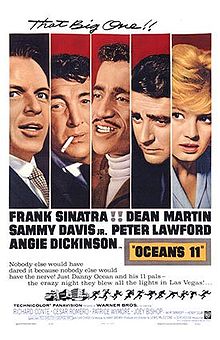
Ocean's Eleven (1960) is the code name for the 82nd Airborne, a group of men who, 15 years after the end of WWII, decide to have a most unusual kind of army buddy reunion. The old gang, led by Danny Ocean (Frank Sinatra, exuding martini glass class) and his right hand man Sam Harmon (Dean Martin before his pickled years), are recruited for a big casino heist in Las Vegas. Not just one casino, but five in one night, New Year's Eve to be precise. Flown in from all corners of the nation are Jimmy Foster (dashing Peter Lawford), one-eyed soul brother Josh Howard (Sammy Davis, Jr.), stone-faced Roger Corneal (Henry Silva, at the start of a long career of low-budget film heavies), goofy 'Curly' Steffans (B-movie character actor Richard Benedict), 'Mugsy' O'Connors (a petrified Joey Bishop), wisecracking Peter Rheimer (a pre-Mr. Roper Norman Fell), cowboy Louis Jackson (westerns regular Clem Harvey), and Vince Massler (stand-up comic Buddy Lester). The final man, Tony Bergdorf (Richard Conte), is sprung early from a 1-5 stint in prison, and takes on the mission for melodramatic reasons; he is suffering from a terminal heart disease and wants to put his son through college after his death. The mastermind behind the heist is Greek tycoon Spyros Acebos (hammy Akim Tamiroff), who also funds the operation.
Lewis Milestone, active since the silent era and best known for his action flicks, is an odd choice to direct this ultimate Rat Pack film that is better known for its cast than its cinematic quality. Who needs a good movie when you have Sinatra, Lawford, Martin, Bishop, and Davis, Jr.? At the risk of sounding like a heretic, Soderbergh's re-imagining of this comic adventure is far more satisfying than the original, even with Julia Roberts as a poor stand-in for Angie Dickinson (not really a fair trade, though they're mildly similar). What stops Ocean's Eleven from being a great caper film is the fact that it's not really a caper film. It's a personality film, built on the star persona of its ensemble cast. Thankfully this doesn't mean the movie is a complete waste. The chemistry between the eleven is incredibly suave and sophisticated, and a hell of a lot of fun to watch. Even though the plan isn't fully fleshed out or even plausible, the charisma of the cast sells it...only barely. To be sure, this is not an unjustly maligned caper feature. There are more than enough reasons to dislike it. The movie stops cold for songs from Davis, Jr. in his introductory scene, Martin serenading a bunch of maids in his hotel and acting as distracting entertainment during the heist singing "Ain't That a Kick in the Head", but somehow refrains from allowing Sinatra to croon. The romantic subplot attempting to reunite Danny and his estranged wife Beatrice (Angie Dickinson, in her youth resembling and sounding like Robin Wright Penn) tends to be hokey and awash with silly lines ("I just woke up one morning and realized there was nothing underneath us but thin air"). I will give Beatrice credit for some choice barbs when Danny's mistress phones her at home. Even with Mrs. Ocean providing some bite to the proceedings, no offense to womankind but unless you're involved with the crime itself, make yourself scarce in heist films, ladies. Your roles will be thankless and the audience views you as a distraction from the real thrust of the film. Take into further consideration Ilka Chase as Foster's mother, whose sole purpose in the narrative is to be engaged to Duke Santos, a retired gangster (delightfully smarmy Cesar Romero) who catches wind of the heist and demands a percentage of the stolen money to keep him from exposing their crime.
Overlong at 127 minutes, Milestone could have easily tightened this to a much better 100-minute feature. Still, if you've been avoiding this film for whatever reason, you don't need to put off seeing it any longer. Fun cameos by Red Skelton as himself (trying to exceed his limit at one of the casinos), former gangster film regular George Raft as a casino owner who calls Duke in for advising on the robbery, and Shirley Maclaine, the sole female member of the Rat Pack, as a drunk party girl cement the generally good time to be had with Ocean and his eleven. It really is cool, cats.
Original theatrical trailer for Ocean's Eleven (1960)
The same year as Milestone's light-hearted all-star color hit from Warner Brothers, 20th Century-Fox's veteran contract director, Henry Hathaway, provided a more serious black-and-white alternative, Seven Thieves (1960). Replacing Vegas with Monte Carlo, and downplaying the star power while also escalating the talent level (sorry, Rat Pack), Hathaway's film is a marvelous surprise that has remained practically ignored in discussion of caper films over the years.
Fresh out of the clink and anxious to return to America, Paul Mason (Rod Steiger, superb as always) meets up with old friend Theo Wilkins (Edward G. Robinson, also predictably wonderful), a disgraced scientist and professor who has retreated to Monte Carlo to lick his wounds. His vacation time has led to him hatching an interesting business opportunity for Paul, or as he puts it, "a dramatically unique venture in piracy." A heist of $4 million in francs from Monte Carlo's most prestigious casino, using a team of seven, is Wilkins' plan to "make the world gasp one more time." He has already enlisted the aid of Poncho (post-Baby Doll, pre-Ugly Eli Wallach), a club saxophone player, and Melanie (a very young Joan Collins), the club's dancer, who performs the worst routine I've ever seen (and I watch Something Weird striptease movies). Insider Raymond Le May (Alexander Scourby), executive secretary to the casino's director (magnificently bearded Sebastian Cabot), is smitten with Melanie, and goes along with the plan to prove his love for her. Handsome gigolo Louis Antonizzi (Michael Dante, the town pervert in The Naked Kiss), an expert in blowing safes, and sinister muscle Hugo Baumer (popular villain Berry Kroeger) complete the septet with Paul's acceptance of the offer. The scheme is to pose as famous aristocrats for an annual ball held at the casino, providing them inside access to the safe. Naturally, the mission doesn't go off without a few hitches or two...
Based on a novel by Max Cotto and written by the film's producer, Sydney Boehm, Seven Thieves excels most impressively in the dialogue department. Asked to have faith in the original plan, Paul retorts, "Cemeteries are full of people who had faith." He is full of delicious bons mot like these, which keep the pre-heist half of the film consistently entertaining. When the heist is underway, Hathaway's taut direction (including choice removals of musical score from suspenseful moments) provides edge of your seat suspense as Paul and Louis scale the casino's wall, dangling above a mile-high cliff, and narrowly avoid activating an alarm sensor, Melanie's identity fraud is threatened, and an important cyanide capsule jeopardizes the success of the heist. Performances are all around excellent, with special notice necessarily paid to Collins, who some forget was an admirable ingenue and actress before she became the campy queen of mean in the 1970s and 1980s. Superb pacing, beautiful CinemaScope photography, a sharp script and interesting characters, and a nail-biting heist make this one of the best caper films you've never seen, even with an anti-climactic ending.
Better than both 1960 films is Jean-Pierre Melville's Bob le Flambeur (1955), a classic deserving of its acclaim. A financial failure upon its release, the film was praised by critics Truffaut and Godard and developed a cult following over the years, counting among its members Stanley Kubrick, who reportedly vowed to give up making crime films after seeing Bob because he believed Melville had perfected the genre. Melville, one of the masters of French cinema, whether you've heard of him or not, borrows from American crime films of the 1940s and early 1950s, but with a distinctive Gallic twist that makes this a uniquely thrilling yarn.
Living in the rundown Montmarte district of 1950s Paris is Bob, a has-been hood respected and admired by everyone in the neighborhood, even as he swirls deeper and deeper into dire financial straits due to a gambling problem. Out of a cunning sense of desperation to make one last grasp at success, he hatches a scheme to rob a Deauville casino on the night of the Grand Prix, recruiting his old friend Roger, inside man Jean, and young Paolo, the impressionable son of a former partner-in-crime,as well as a pair of gunmen. Funding the operation is the sinister McKimmie (played by future Jess Franco regular Howard Vernon). Thrown into the mix is Anne, a beautiful young prostitute rescued from the streets by Bob and pushed into Paolo's bed as a potential companion. The heat is on when Anne accidentally reveals the heist plan to Marc, a slimy pimp anxious to give the cops a hot tip to save his own ski, and Jean's scheming wife (shades of marvelous Marie Windsor in Kubrick's The Killing) catches wind of the plan and demands her husband get a larger cut of the score.
The genius of Melville's film is that its suspense is not in the heist itself, but the interaction between the characters discussing and leading up to the crime. These are desperate men, anxious to prove themselves to their friends, their women, the world, and this one 800 million franc robbery will leave them made in the shade for life. This desperation is what drives the film, as Melville places his characters in shabby apartments, fleapit bars, and scummy streets, recalling American pre-Code crime films of the 1930s. Even Bob's detective pal feeds into this aura of desperation as he frantically searches for his friend to stop him from sure self-destruction. It's quite a film that has the audience anxious for the heist to be pulled off one minute, then rooting for it to be stopped the next. Melville would prove most successful as a director of crime films, including such wonderful offerings as Le Samourai (1967), Le Doulos (1962), and Le Cercle Rouge (1970), and with its inventive editing, absorbing cinematography, and convincing and caring characterizations, Bob le Flambeur is a perfect introduction to his oeuvre.
And then there was Kaleidoscope (1966)... Sigh...how do you follow up three good, sometimes great, caper films with a psychedelic 60s genre entry? It's a definite change of pace, part smarmy playboy travelogue, part Bond-inspired crime thriller, and not an entirely successful melange of genres. The film co-stars Warren Beatty and Susannah York, so at least delivers on the suave and slinky visual appeal. But with sluggish pacing in the first half, TV director Jack Smight's eye-popping color caper
Worldly playboy Barney Lincoln (Beatty) takes cheating at cards to a whole 'nother level when he breaks into a playing card company and marks the original printing plates, following the cards as they make their way through the top casinos in Europe and making a killing at the tables. He begins romancing swinging Carnaby Street boutique owner Angel McGinnis (York), whose father, Scotland Yard inspector "Manny" McGinnis (The Legend of Hell House's Clive Revill), recognizes his scam and aims to blackmail him into using it to his advantage. Arch villain, drug kingpin Harry Dominion (Hands of the Ripper's Eric Porter), is at the top of Manny's hit list, so a plan is hatched to bankrupt Dominion's crime empire through a simple game of poker with Lincoln's marked cards. Sound familiar?
Much has been made by contemporary Bond fans of the similarities between this film and Ian Fleming's original "Casino Royale" novel, which makes for interesting trivia but only really applies to the film's much more successful second half. Before the true purpose of the film's narrative is revealed, we're subjected to obnoxious sequences of Beatty winning big and wooing York, who starts as an intriguing character before becoming a rather lame romantic interest. It is the second half that saves Kaleidoscope from utter mediocrity, with its campy super villain (who eliminates a traitor with a flamethrower), Scotland Yard heroism (McGinnis is a charming, nervy authority figure), and a finally likable hero. In an attempt to appeal to the hip youthful generation of the late 1960s, kaleidoscopic transitions, bright flashy color gels, and a sitar score are added to what is otherwise a fairly conventional comic thriller. Jane Birkin (in Blow-Up the same year) appears as an excitable boutique customer, and dig those craaaazy zooms, man! The last film Beatty made before Bonnie and Clyde (1967) transformed him into an entirely different kind of Hollywood personality, this is maybe best viewed as a transition piece between the challenging character pieces he frequented in the earlier half of the decade and the decade in which he would work with many American auteurs, influencing his eventual move behind the camera. Not an essential film to seek out, but if you'd like to see what many claim is "the original Casino Royale", by all means grab the Warner Archive Collection release.
The final film of the night, airing in the wee hours of the morning, was 5 Against the House (1955), an obscure Columbia thriller released on DVD as part of the Columbia Film Noir Classics Collection. Whatta cast! A pre-Vertigo Kim Novak is the sexual centerpiece, but the other four "against the house" are handsome piece of 50s cinema furniture Guy Madison, Brian Keith before "Family Affair" neutered him, gay actor Kerwin Matthews shortly before he went on The 7th Voyage of Sinbad, and Alvy Moore (who later teamed up with L.Q. Jones to produce independent horror films like The Witchmaker and The Brotherhood of Satan).
Al, Brick, Roy, and Ronnie, four former G.I. buddies, take a break from college for a night at a casino, where they witness the arrest of a hold-up man who underestimates the house security. For kicks, the group decides to head back and rob the casino, except they won't keep the money (huh?), labeling it as a psychological experiment. Uh...ok.... The plan takes a turn when Brick decides to keep the money and uses a gun to get his point across. The fifth person against the house is Al's fiancee Kay, dragged into the plan solely to involve a woman in the plot. Along for the ride is TV favorite William Conrad, a great noir face in 1946's The Killlers before tracking down criminals as "Cannon" and "Nero Wolfe", forced to aid the group in the heist.
Yeah...this is a turd of a movie. Columbia, an indie studio that produced more than its fair share of underrated features in the golden age of Hollywood, churned out a sorely disappointing film that is neither noir nor caper. Stirling Silliphant's first screenplay might have played out nicely slimmed down as a 50s TV anthology play, but there is no logic behind the characters or their motivations, except for Brick. Perhaps the whole film should have simply been about Brick falling on the wrong side of the law. His unresolved issues of Korean War combat shock result in violent outbursts, scenes that elevate the film's general light tone into something of interest. As Brick, Brian Keith is the star of the show. No one else makes any real impression, which is further disappointing considering the cast's pedigree. Hell there are two musical numbers for no reason, both dubbed by Jo Ann Greer because Novak is no singer. And the ending is beyond ridiculous. 5 Against the House is nothing special, but the DVD collection it's a part of is essential.
Ocean's Eleven (1960) is the code name for the 82nd Airborne, a group of men who, 15 years after the end of WWII, decide to have a most unusual kind of army buddy reunion. The old gang, led by Danny Ocean (Frank Sinatra, exuding martini glass class) and his right hand man Sam Harmon (Dean Martin before his pickled years), are recruited for a big casino heist in Las Vegas. Not just one casino, but five in one night, New Year's Eve to be precise. Flown in from all corners of the nation are Jimmy Foster (dashing Peter Lawford), one-eyed soul brother Josh Howard (Sammy Davis, Jr.), stone-faced Roger Corneal (Henry Silva, at the start of a long career of low-budget film heavies), goofy 'Curly' Steffans (B-movie character actor Richard Benedict), 'Mugsy' O'Connors (a petrified Joey Bishop), wisecracking Peter Rheimer (a pre-Mr. Roper Norman Fell), cowboy Louis Jackson (westerns regular Clem Harvey), and Vince Massler (stand-up comic Buddy Lester). The final man, Tony Bergdorf (Richard Conte), is sprung early from a 1-5 stint in prison, and takes on the mission for melodramatic reasons; he is suffering from a terminal heart disease and wants to put his son through college after his death. The mastermind behind the heist is Greek tycoon Spyros Acebos (hammy Akim Tamiroff), who also funds the operation.
Lewis Milestone, active since the silent era and best known for his action flicks, is an odd choice to direct this ultimate Rat Pack film that is better known for its cast than its cinematic quality. Who needs a good movie when you have Sinatra, Lawford, Martin, Bishop, and Davis, Jr.? At the risk of sounding like a heretic, Soderbergh's re-imagining of this comic adventure is far more satisfying than the original, even with Julia Roberts as a poor stand-in for Angie Dickinson (not really a fair trade, though they're mildly similar). What stops Ocean's Eleven from being a great caper film is the fact that it's not really a caper film. It's a personality film, built on the star persona of its ensemble cast. Thankfully this doesn't mean the movie is a complete waste. The chemistry between the eleven is incredibly suave and sophisticated, and a hell of a lot of fun to watch. Even though the plan isn't fully fleshed out or even plausible, the charisma of the cast sells it...only barely. To be sure, this is not an unjustly maligned caper feature. There are more than enough reasons to dislike it. The movie stops cold for songs from Davis, Jr. in his introductory scene, Martin serenading a bunch of maids in his hotel and acting as distracting entertainment during the heist singing "Ain't That a Kick in the Head", but somehow refrains from allowing Sinatra to croon. The romantic subplot attempting to reunite Danny and his estranged wife Beatrice (Angie Dickinson, in her youth resembling and sounding like Robin Wright Penn) tends to be hokey and awash with silly lines ("I just woke up one morning and realized there was nothing underneath us but thin air"). I will give Beatrice credit for some choice barbs when Danny's mistress phones her at home. Even with Mrs. Ocean providing some bite to the proceedings, no offense to womankind but unless you're involved with the crime itself, make yourself scarce in heist films, ladies. Your roles will be thankless and the audience views you as a distraction from the real thrust of the film. Take into further consideration Ilka Chase as Foster's mother, whose sole purpose in the narrative is to be engaged to Duke Santos, a retired gangster (delightfully smarmy Cesar Romero) who catches wind of the heist and demands a percentage of the stolen money to keep him from exposing their crime.
Overlong at 127 minutes, Milestone could have easily tightened this to a much better 100-minute feature. Still, if you've been avoiding this film for whatever reason, you don't need to put off seeing it any longer. Fun cameos by Red Skelton as himself (trying to exceed his limit at one of the casinos), former gangster film regular George Raft as a casino owner who calls Duke in for advising on the robbery, and Shirley Maclaine, the sole female member of the Rat Pack, as a drunk party girl cement the generally good time to be had with Ocean and his eleven. It really is cool, cats.
Original theatrical trailer for Ocean's Eleven (1960)
The same year as Milestone's light-hearted all-star color hit from Warner Brothers, 20th Century-Fox's veteran contract director, Henry Hathaway, provided a more serious black-and-white alternative, Seven Thieves (1960). Replacing Vegas with Monte Carlo, and downplaying the star power while also escalating the talent level (sorry, Rat Pack), Hathaway's film is a marvelous surprise that has remained practically ignored in discussion of caper films over the years.
Fresh out of the clink and anxious to return to America, Paul Mason (Rod Steiger, superb as always) meets up with old friend Theo Wilkins (Edward G. Robinson, also predictably wonderful), a disgraced scientist and professor who has retreated to Monte Carlo to lick his wounds. His vacation time has led to him hatching an interesting business opportunity for Paul, or as he puts it, "a dramatically unique venture in piracy." A heist of $4 million in francs from Monte Carlo's most prestigious casino, using a team of seven, is Wilkins' plan to "make the world gasp one more time." He has already enlisted the aid of Poncho (post-Baby Doll, pre-Ugly Eli Wallach), a club saxophone player, and Melanie (a very young Joan Collins), the club's dancer, who performs the worst routine I've ever seen (and I watch Something Weird striptease movies). Insider Raymond Le May (Alexander Scourby), executive secretary to the casino's director (magnificently bearded Sebastian Cabot), is smitten with Melanie, and goes along with the plan to prove his love for her. Handsome gigolo Louis Antonizzi (Michael Dante, the town pervert in The Naked Kiss), an expert in blowing safes, and sinister muscle Hugo Baumer (popular villain Berry Kroeger) complete the septet with Paul's acceptance of the offer. The scheme is to pose as famous aristocrats for an annual ball held at the casino, providing them inside access to the safe. Naturally, the mission doesn't go off without a few hitches or two...
Based on a novel by Max Cotto and written by the film's producer, Sydney Boehm, Seven Thieves excels most impressively in the dialogue department. Asked to have faith in the original plan, Paul retorts, "Cemeteries are full of people who had faith." He is full of delicious bons mot like these, which keep the pre-heist half of the film consistently entertaining. When the heist is underway, Hathaway's taut direction (including choice removals of musical score from suspenseful moments) provides edge of your seat suspense as Paul and Louis scale the casino's wall, dangling above a mile-high cliff, and narrowly avoid activating an alarm sensor, Melanie's identity fraud is threatened, and an important cyanide capsule jeopardizes the success of the heist. Performances are all around excellent, with special notice necessarily paid to Collins, who some forget was an admirable ingenue and actress before she became the campy queen of mean in the 1970s and 1980s. Superb pacing, beautiful CinemaScope photography, a sharp script and interesting characters, and a nail-biting heist make this one of the best caper films you've never seen, even with an anti-climactic ending.
Better than both 1960 films is Jean-Pierre Melville's Bob le Flambeur (1955), a classic deserving of its acclaim. A financial failure upon its release, the film was praised by critics Truffaut and Godard and developed a cult following over the years, counting among its members Stanley Kubrick, who reportedly vowed to give up making crime films after seeing Bob because he believed Melville had perfected the genre. Melville, one of the masters of French cinema, whether you've heard of him or not, borrows from American crime films of the 1940s and early 1950s, but with a distinctive Gallic twist that makes this a uniquely thrilling yarn.
Living in the rundown Montmarte district of 1950s Paris is Bob, a has-been hood respected and admired by everyone in the neighborhood, even as he swirls deeper and deeper into dire financial straits due to a gambling problem. Out of a cunning sense of desperation to make one last grasp at success, he hatches a scheme to rob a Deauville casino on the night of the Grand Prix, recruiting his old friend Roger, inside man Jean, and young Paolo, the impressionable son of a former partner-in-crime,as well as a pair of gunmen. Funding the operation is the sinister McKimmie (played by future Jess Franco regular Howard Vernon). Thrown into the mix is Anne, a beautiful young prostitute rescued from the streets by Bob and pushed into Paolo's bed as a potential companion. The heat is on when Anne accidentally reveals the heist plan to Marc, a slimy pimp anxious to give the cops a hot tip to save his own ski, and Jean's scheming wife (shades of marvelous Marie Windsor in Kubrick's The Killing) catches wind of the plan and demands her husband get a larger cut of the score.
The genius of Melville's film is that its suspense is not in the heist itself, but the interaction between the characters discussing and leading up to the crime. These are desperate men, anxious to prove themselves to their friends, their women, the world, and this one 800 million franc robbery will leave them made in the shade for life. This desperation is what drives the film, as Melville places his characters in shabby apartments, fleapit bars, and scummy streets, recalling American pre-Code crime films of the 1930s. Even Bob's detective pal feeds into this aura of desperation as he frantically searches for his friend to stop him from sure self-destruction. It's quite a film that has the audience anxious for the heist to be pulled off one minute, then rooting for it to be stopped the next. Melville would prove most successful as a director of crime films, including such wonderful offerings as Le Samourai (1967), Le Doulos (1962), and Le Cercle Rouge (1970), and with its inventive editing, absorbing cinematography, and convincing and caring characterizations, Bob le Flambeur is a perfect introduction to his oeuvre.
And then there was Kaleidoscope (1966)... Sigh...how do you follow up three good, sometimes great, caper films with a psychedelic 60s genre entry? It's a definite change of pace, part smarmy playboy travelogue, part Bond-inspired crime thriller, and not an entirely successful melange of genres. The film co-stars Warren Beatty and Susannah York, so at least delivers on the suave and slinky visual appeal. But with sluggish pacing in the first half, TV director Jack Smight's eye-popping color caper
Worldly playboy Barney Lincoln (Beatty) takes cheating at cards to a whole 'nother level when he breaks into a playing card company and marks the original printing plates, following the cards as they make their way through the top casinos in Europe and making a killing at the tables. He begins romancing swinging Carnaby Street boutique owner Angel McGinnis (York), whose father, Scotland Yard inspector "Manny" McGinnis (The Legend of Hell House's Clive Revill), recognizes his scam and aims to blackmail him into using it to his advantage. Arch villain, drug kingpin Harry Dominion (Hands of the Ripper's Eric Porter), is at the top of Manny's hit list, so a plan is hatched to bankrupt Dominion's crime empire through a simple game of poker with Lincoln's marked cards. Sound familiar?
Much has been made by contemporary Bond fans of the similarities between this film and Ian Fleming's original "Casino Royale" novel, which makes for interesting trivia but only really applies to the film's much more successful second half. Before the true purpose of the film's narrative is revealed, we're subjected to obnoxious sequences of Beatty winning big and wooing York, who starts as an intriguing character before becoming a rather lame romantic interest. It is the second half that saves Kaleidoscope from utter mediocrity, with its campy super villain (who eliminates a traitor with a flamethrower), Scotland Yard heroism (McGinnis is a charming, nervy authority figure), and a finally likable hero. In an attempt to appeal to the hip youthful generation of the late 1960s, kaleidoscopic transitions, bright flashy color gels, and a sitar score are added to what is otherwise a fairly conventional comic thriller. Jane Birkin (in Blow-Up the same year) appears as an excitable boutique customer, and dig those craaaazy zooms, man! The last film Beatty made before Bonnie and Clyde (1967) transformed him into an entirely different kind of Hollywood personality, this is maybe best viewed as a transition piece between the challenging character pieces he frequented in the earlier half of the decade and the decade in which he would work with many American auteurs, influencing his eventual move behind the camera. Not an essential film to seek out, but if you'd like to see what many claim is "the original Casino Royale", by all means grab the Warner Archive Collection release.
The final film of the night, airing in the wee hours of the morning, was 5 Against the House (1955), an obscure Columbia thriller released on DVD as part of the Columbia Film Noir Classics Collection. Whatta cast! A pre-Vertigo Kim Novak is the sexual centerpiece, but the other four "against the house" are handsome piece of 50s cinema furniture Guy Madison, Brian Keith before "Family Affair" neutered him, gay actor Kerwin Matthews shortly before he went on The 7th Voyage of Sinbad, and Alvy Moore (who later teamed up with L.Q. Jones to produce independent horror films like The Witchmaker and The Brotherhood of Satan).
Al, Brick, Roy, and Ronnie, four former G.I. buddies, take a break from college for a night at a casino, where they witness the arrest of a hold-up man who underestimates the house security. For kicks, the group decides to head back and rob the casino, except they won't keep the money (huh?), labeling it as a psychological experiment. Uh...ok.... The plan takes a turn when Brick decides to keep the money and uses a gun to get his point across. The fifth person against the house is Al's fiancee Kay, dragged into the plan solely to involve a woman in the plot. Along for the ride is TV favorite William Conrad, a great noir face in 1946's The Killlers before tracking down criminals as "Cannon" and "Nero Wolfe", forced to aid the group in the heist.
Yeah...this is a turd of a movie. Columbia, an indie studio that produced more than its fair share of underrated features in the golden age of Hollywood, churned out a sorely disappointing film that is neither noir nor caper. Stirling Silliphant's first screenplay might have played out nicely slimmed down as a 50s TV anthology play, but there is no logic behind the characters or their motivations, except for Brick. Perhaps the whole film should have simply been about Brick falling on the wrong side of the law. His unresolved issues of Korean War combat shock result in violent outbursts, scenes that elevate the film's general light tone into something of interest. As Brick, Brian Keith is the star of the show. No one else makes any real impression, which is further disappointing considering the cast's pedigree. Hell there are two musical numbers for no reason, both dubbed by Jo Ann Greer because Novak is no singer. And the ending is beyond ridiculous. 5 Against the House is nothing special, but the DVD collection it's a part of is essential.
Tuesday, January 8, 2013
Last Night on TCM...: Guest Programmer Bill Paxton
One of the most intriguing and entertaining monthly events on Turner Classic Movies' schedule is the Guest Programmer night. It gives viewers a chance to see the films that contemporary actors, directors, and other personalities (critics, bloggers, the viewers themselves) would choose if they could program a night of classic films with significant and/or sentimental value. Not only does it reveal the wide appeal and influence of films of yesteryear, but it provides a window into the off-screen personalities of the programmers, who in some cases you would never guess know the first thing about their cinematic predecessors. There are very few instances I can remember where a guest programmer picked glaringly obvious films of the past (Raquel Welch and Cloris Leachman among them). Tim Roth scheduled the obscure and wonderful British indie Cathy, Come Home (1966), "SNL" funny man Bill Hader selected the oddball Robert Altman offering Brewster McCloud (1970), and of all Preston Sturges' classics, Sally Field picked perhaps the most frequently overlooked, The Miracle of Morgan's Creek (1944). If there is one night to check out TCM, I'd recommend the Guest Programmer schedule. It wisely connects contemporary sensibilities to the sometimes hard to sell world of classic films, making otherwise inaccessible films appealing to a wider audience.
January 7's guest programmer Bill Paxton, best-known for his character roles in the James Cameron films Aliens (1986) and True Lies (1994), is someone I've admired from his work in the self-directed, and still underrated, Frailty (2002) and HBO's engaging polygamy melodrama "Big Love" (2006-2011). With his Midwestern accent and aw-shucks persona, one could easily predict an entirely different lineup of films than the ones he actually did choose to spotlight last night. Paxton made wise selections, two foreign classics and two oft-neglected films of the 1970s New American Cinema.
After discussing his father's love of film influencing his tastes over the years, Paxton introduces Juliet of the Spirits (1965), a film he first saw at 18, driving all the way from Ft. Worth, TX to Hollywood to see it. Even all these years later, Federico Fellini seems under-discussed for my film school tastes. Perhaps it's because the French New Wave, Welles, and Hitchcock seem to receive the lion's share of scholarly attention these days, leaving auteurs previously lauded in the 1970s (Bergman, Truffaut, De Sica) to followers of the Criterion Collection. Unlike other directors of his era, Fellini seems to truly adore film as an artist's canvas. He has tremendous fun with visual style and storytelling, even in frequently incomprehensible films like Satyricon (1969). I will admit, I was not an immediate fan of Fellini's work. It seemed pretentious and rang false when viewed at a young age. As I grow older, revisiting them reveals some of the genuine treasures of world cinema. Once you see and love one of his films, you will want to see all of them. For my money, Fellini's masterpiece is his most personal, Amarcord (1973), a film detailing the beauty and tragedy of wistful nostalgia (and the only Fellini film to bring me to tears), but Juliet, his first color film, is a clear frontrunner in his filmography. All directors should have had such a delightful, masterful introduction to color, but Juliet is a unique beast that continues to reward viewers with multiple viewings. While a few of Fellini's other films have arrived on Blu-Ray, the one that would work as a great test disc for your new player and 16x9 TV would be Juliet, if and when it finally appears on the format. I envy Paxton being able to see this candy-colored wonder on the big screen.
On the evening of their 15th wedding anniversary, Giulietta (Fellini's wife, Giuletta Mesina, one of many cast and character names crossing the line between fact and fiction) and her husband Giorgio have their closest friends over for a surprise party. One of their guests, a renowned medium, oversees a seance that seems to bring a spirit named Iris into the participants' midst. From that moment, Giulietta begins having unusual visions and dreams, connecting her to another realm, perhaps an alternate universe, informed by her distrust of her husband and memories of past and current relationships with family, friends, and lovers. An unusual encounter with an elderly clairvoyant, a visit by a seductive yet sinister Spanish friend of Giorgio's, and an extravagant passion play are only a few of the unusual set pieces Fellini asks the audience to absorb. Juliet is, like most of Fellini's films, not grounded by narrative. He provides the vaguest hint of a story on which to hang his striking visual tableaux, letting his camera run wild capturing entrancing outdoor scenarios and the lavish yet empty homes of the vapid wealthy. His focus on mysticism veers into the ludicrous, not unintentionally, and overall this is not a film that many viewers will like or maybe even be able to tolerate on first viewing. But it just may grow on you as it has on me. Fans of European exploitation will no doubt recognize Milena Vukotic (Blood for Dracula) as Giulietta's maid Elisabetta, Valentina Cortese (The Girl who Knew Too Much) as Giulietta's theatrical best friend Valentina, Mary Arden (Blood and Black Lace) on a black-and-white television set, and of course Sylva Koscina, who began her career in peplums and would continue appearing nude into her 50s, as (surprise) Sylva, Giulietta's flighty and vivacious actress neighbor.The Spirit of the Beehive (1973) is a decidedly more obscure title that perhaps only Criterion worshipers know about. Paxton saw this film first via an awful quality VHS tape lent to him by Jim Brown, one of his NYU professors (wow, Paxton and I share an alma mater). Taking place near the end of the Spanish Civil War (a conflict that would also influence Spanish cinema through the decade that produced this film), a small village is visited by a traveling roadshow projectionist, carrying a print of James Whale's Frankenstein (1931). The film delights and terrifies the town's children, making the greatest impression on young Ana (Ana Torrent, giving one of the most natural and winning child performances in film), the daughter of Fernando, a local beekeeper, and his wife Teresa. Ana's sister, Isabel, tells her that she has seen the Monster in an abandoned farmhouse outside the village, leading the inquisitive girl to seek out the movie monster for herself. To give away more would take away from the pleasure of experiencing this film for the first time.
A beautiful film about film and its transformative qualities, Beehive remains a relatively undiscovered gem sure to bewitch audiences discovering it for the first time. If you have seen and love Cinema Paradiso (1989) and Pan's Labyrinth (2006), directors Giuseppe Tornatore and Guillermo del Toro borrowed several ideas from this film for their masterpieces. That said, Victor Erice's film is a unique story told primarily from the child's point of view. The young sisters are each other's best friend, forming a camaraderie that feels genuine and sweet. Their relationship with their parents is rarely presented in any detail, though a marvelous sequence of Fernando showing his daughters the different mushrooms growing in the woods around their home is a revealing one. Beautifully photographed and compellingly written, this is a film you will want to own and revisit over time to peel away the many political and cultural layers to be found here. Torrent would return a few years later in Carlos Saura's haunting classic Cria Cuervos (1976), in another bravura performance. It is too appropriate that Criterion has brought both of her wonderful childhood roles to DVD.Given a choice of a Robert Altman film to program, I imagine Nashville (1975), McCabe and Mrs. Miller (1971), M*A*S*H* (1970), and The Player (1992) would be the first titles to come to mind, if not Short Cuts (1993) or Gosford Park (2001). But Altman did more films that are forgotten than are fondly remembered. I already mentioned Bill Hader showing Brewster McCloud on his Guest Programmer night (Hader's taste is to be admired), and Paxton's recalling California Split (1974) is a surprise indeed. The Sony DVD is long out of print, and it's a film that's easy to gloss over in favor of, say, Thieves Like Us from the same year. The only way I could have been more surprised would have been if he picked Come Back to the Five and Dime, Jimmy Dean, Jimmy Dean (1982). Actually, I wish he had.
Reuniting Altman with his M*A*S*H* and Long Goodbye (1973) star Elliott Gould and, unusually, marking a collaboration with soap TV producers Aaron Spelling and Leonard Goldberg, California Split is not a favorite Altman of mine. The actors' director liked to tackle genres and subjects he had little to no knowledge of, like the country music world in Nashville and ballet dancers in The Company (2003), though the subsequent films never end up being about their proposed subject. Here he takes on competitive poker playing and, true to form, it's really about male bonding while living on the edge. Gould and George Segal play Charlie and Bill, two card sharks who become chummy after running into each other at a gambling club, where they both are cheating their fellow players. They're tossed in jail and bailed out by Charlie's pals, a pair of goofy hookers named Barbara and Susan. Bill indulges in a bit of hero worship of Charlie, driving him into debt until the pair decide to join forces and trek to Reno for one last big win at a national poker competition.

The lack of narrative has never deterred me from liking an Altman film, or any film, before, but it helps when such a film has compelling characters. There is nothing remotely interesting about Charlie or Bill, and their female counterparts are poorly underwritten. Altman's style of overlapping dialogue is rendered irritating beyond belief when it serves no purpose, uttered by cartoonish characters. Of course, this being Altman, the cast is terrific. In addition to Gould and Segal, you also get two pre-Nashville cast members (Gwen Welles and Jeff Goldblum), Paula Prentiss' tragic sister Ann in her best role, Barbara Colby as Bill's receptionist, a year before her tragic murder while shooting the TV series "Phyllis", loudmouthed redhead character actress Mickey Fox (Caged Heat) in the opening poker sequence, and character actor Tom Signorelli (Alice, Sweet Alice). All in all, though, a pretty stinky blemish on Altman's resume.
The Last Detail (1973) is a pretty wonderful capper for the evening. Hal Ashby, the most underrated of the new American cinema directors of the 1970s, followed up his box office disaster Harold and Maude (1971) with this much more successful and acclaimed feature. An underrated actors' director, Ashby taps into the surprising range of Jack Nicholson, during his best years as an actor, in a touching story of male bonding and companionship. Paxton even goes so far to say this is Nicholson's greatest performance. It's certainly up there. Ashby continued his bounce back into the big time with Shampoo (1975), Bound for Glory (1976), Coming Home (1978), and Being There (1979), but in the process, his earlier work (also including 1970's The Landlord) ended up being glossed over. This is a good straddling line between those two periods of his work in the best decade of his all too brief career.
As punishment for lifting $40 from a charity box, sailor Larry Meadows (Randy Quaid) is given eight years in the brig and a dishonorable discharge. Assigned to take him into custody and drag him to a naval prison are Petty Officers Buddusky (Jack Nicholson) and Mulhall (Otis Young), two grizzled vets anxious to drop the kid off early and use his per diem to have a ball on their way back to base. However, as they develop sympathy for the young man, especially upon learning of his virginity, they decide to throw one last hurrah for him on the Armed Forces' dime. Ashby's typically muted visual style allows the story and characters to come alive in a more vivid way. Nicholson, in one of his most animated angry young man roles, anchors the movie, while Quaid, in his first major role outside of a Bogdanovich film, scored an Oscar nomination for his portrayal of an innocent youngster handed a punishment much more severe than the crime. Poor Young is kinda lost in the shuffle, but makes a fine calming third in this oddball trio.
Last Detail also marks the first collaboration between Nicholson and screenwriter Robert Towne, best known for their work together on one of the best films of the 1970s, Chinatown (1974). Towne's Oscar-nominated screenplay has many colorful dialogue exchanges ("I wouldn't shit you. You're my favorite turd." is a favorite) and vividly captures the anger and frustration of young America attempting to function in the Vietnam era, when military institutions were constantly in question. One of the most underrated films of the 1970s, equally humorous, touching, and timely, this is another one to add to the permanent collection.
Standing back and looking at all four films Paxton chose to program, it's interesting to see that the two foreign films view the world through the eyes of imaginative women, and the two American films focus on male bonding over the course of a journey. His interview segments book-ending this quartet indicate a man in great awe of the master directors of the past, especially their work with actors, and their impression on him becomes clear in the films he's made in the director's chair. I especially loved hearing his gushing love for Jack Nicholson and excited plot summary of Spirit of the Beehive. In summary, a great night spent with Bill Paxton and his love of the movies.
Subscribe to:
Posts (Atom)